Skip to content
Search
Menu

We earn a commission if you book through this link. You pay the same price.

A narrow paved road running straight through flat open wetland grass towards a distant horizon
Fred Ward

Trail

Shark Valley

Last updated

A flat 15-mile loop road into open sawgrass with an observation tower at the far end and alligators lying on the verge.

Photo: Fred WardPublic domain

Shark Valley is the Everglades entrance that fits into a Miami morning. It sits directly on the Tamiami Trail, US-41, about 45 minutes west of downtown, and the whole thing is built around one idea: a fifteen-mile paved loop road pushing south into the Shark River Slough and looping back, closed to private cars, with a 65-foot observation tower at the halfway point.

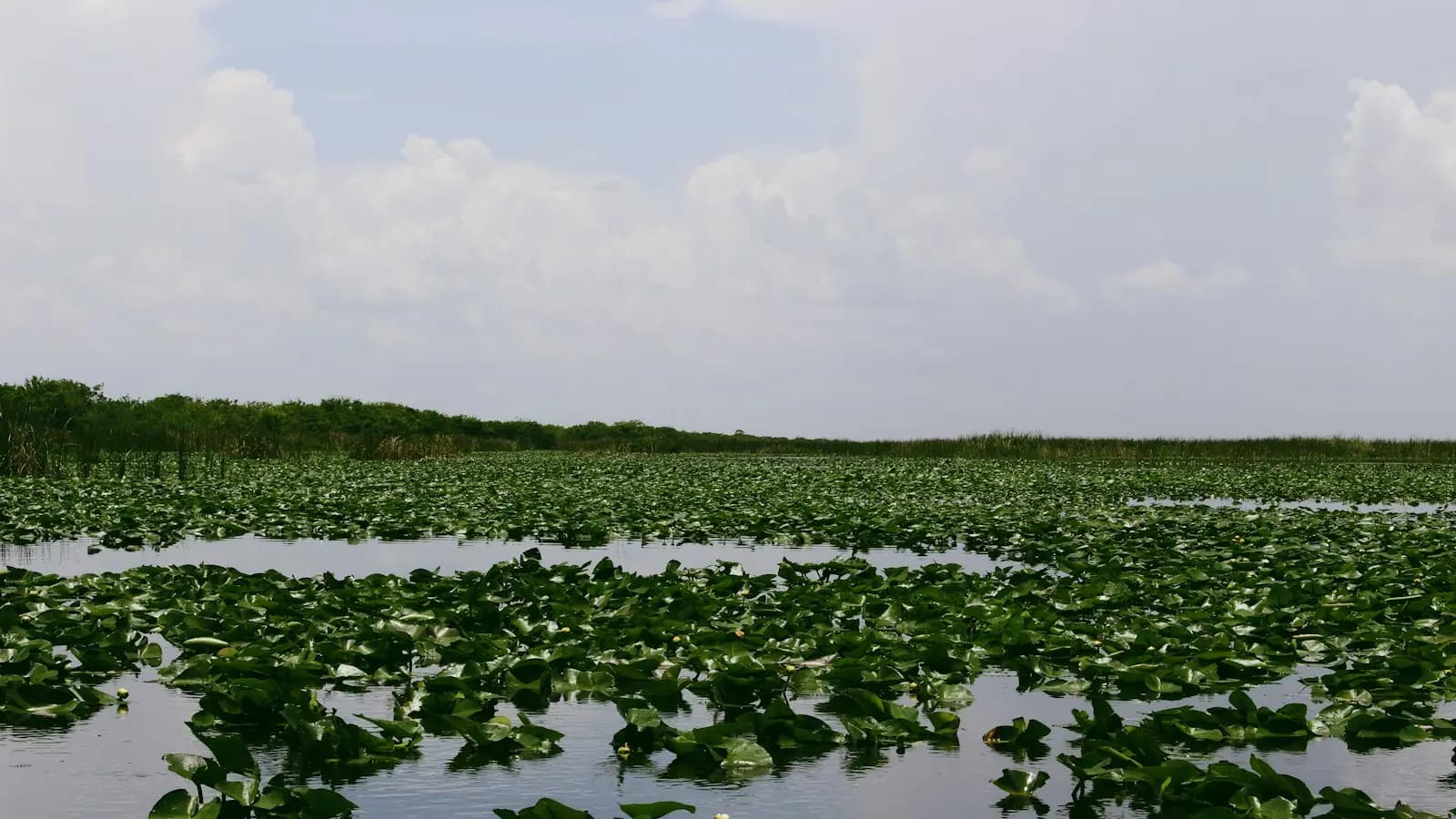
There are no sharks. The name belongs to the slough — the broad, slow channel of freshwater that drains south-west across the park towards the Shark River on the Gulf coast. What Shark Valley gives you is the sheet of the Everglades: sawgrass to the horizon in every direction, tree islands sitting on it like anchored boats, and a sky that takes up four fifths of the view. The tower is the point of the loop. From the top on a clear dry-season day you can see roughly twenty miles across country that never rises above your eye line.

The wildlife here is close in a way that surprises people. The canal dug alongside the road holds water when the surrounding prairie is drying, so in winter alligators haul out on the verge, sometimes within a metre of the tarmac, and simply ignore you. Anhingas dry their wings on the rails. Great blue herons stalk the canal edge. Purple gallinules walk on lily pads. None of it is staged and none of it is fed; it is simply where the water is.

Three ways to travel the loop, and the choice matters. A two-hour naturalist-guided tram covers the whole thing with a stop at the tower. A rented or brought bicycle lets you take four hours over it and stop wherever you like. On foot you will realistically walk a mile or two out and come back, which is enough to be in it but not enough to reach the tower.

One honest warning: there is no shade anywhere on the loop. None.

Getting there and parking

From downtown Miami take the Dolphin Expressway (SR-836) west to the Turnpike, head south briefly, then exit onto SW 8th Street — the Tamiami Trail, US-41 — and drive west. The entrance is on the left about 25 miles along, roughly 45 minutes from the city without traffic. The brown park sign comes up fast on a 55 mph road, so slow early.

Coming from Miami Beach, add 20 to 30 minutes for the causeway and downtown crossing. From Coral Gables or Kendall, take Krome Avenue north to US-41 instead of doubling back through the city.

There is no bus or shuttle. Rideshare will bring you out here in about 45 minutes but will not reliably take you back — drivers do not wait on the Tamiami Trail and coverage is patchy. If you are not driving, book a tour that includes transport, or arrange your return car before you set off.

Tram, bike or feet

The loop is fifteen miles, flat, paved and closed to private vehicles. How you cover it changes the day completely.

  • Tram. Roughly two hours, open-sided, with a park naturalist narrating and a stop of about fifteen minutes at the observation tower. Run by a concessionaire rather than the park service, so it is ticketed separately from your entrance fee. In the December-to-April season it sells out; reserve ahead rather than turning up. Best choice if you have limited time, small children, or anyone in the group who should not be in the sun for hours.
  • Bicycle. Rentals are available at the visitor centre and you may bring your own. Allow three to four hours if you want to stop, which you will. This is the best version of Shark Valley: you set the pace, you get long stretches alone, and you can sit at the tower as long as you like. Bring far more water than feels necessary and start early.
  • Walking. Fine for the first mile or two, where the alligator density is already high. Walking the whole loop is a fifteen-mile round trip with no shade and no water stop, and is not a good idea for most people on most days.

The tram and the bikes share the same single-lane road with walkers. Cyclists: the trams do not swerve, and alligators on the verge do not move for bells.

The observation tower

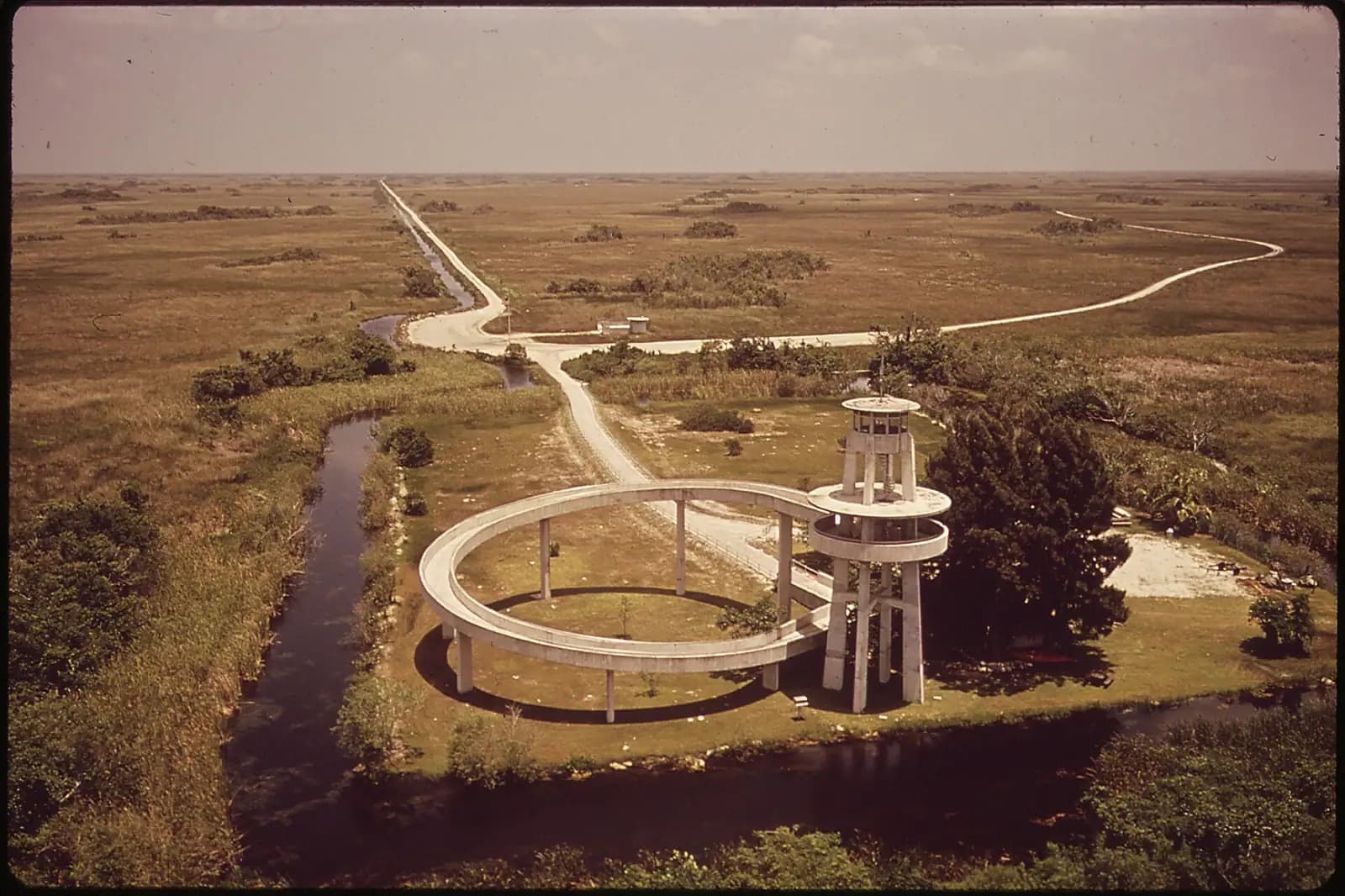
Seven and a half miles in, the road reaches a concrete tower that rises 65 feet out of the sawgrass on a long curving ramp. It was built in the 1960s and it looks it, in a way that has aged into something almost handsome.

The ramp matters practically as well as architecturally: there are no steps, so a wheelchair, a stroller or a bad knee can get to the top. The climb is gradual and takes a few minutes.

What you get is the single best view of the Everglades that does not require a helicopter. In the dry season you can see roughly twenty miles in every direction, and the structure of the place finally makes sense — you can read the slough as a broad, slightly darker channel moving through the sawgrass, with hardwood hammocks standing on it as low islands of tree cover. The borrow pond directly below the tower usually holds alligators, turtles and gar, and the height gives you a view down into water you cannot otherwise see into.

Go at the start or the end of a tram stop rather than the middle if you want the platform to yourself. In summer, the tower is an exposed concrete slab in full sun and fifteen minutes is plenty.

What you will actually see, and when

Shark Valley's wildlife is seasonal in a very literal way, because it follows the water.

Dry season, roughly December to April. The prairie drains, the canal beside the road holds on to water, and everything comes to the canal. Alligators lie on the bank in numbers that genuinely startle first-time visitors. Wading birds — great blue and tricoloured herons, great and snowy egrets, wood storks, roseate spoonbills if you are lucky — work the edges. Anhinga, cormorant, and in the right years large numbers of white ibis. Soft-shell and cooter turtles haul out to bask.

Wet season, roughly May to October. Water spreads back across the whole prairie and the animals spread with it. You will still see alligators, just fewer and further off. The compensations are afternoon thunderheads that make photographs, green sawgrass instead of straw, and far fewer people.

Two things you should know rather than learn the hard way. Alligators on the verge are wild and unmanaged; the park's guidance of staying well back exists because people have been bitten here. And the mosquitoes from June onward are serious enough that a bike ride without repellent is a mistake.
Getting in, and the parking problem

The entrance is on the south side of US-41, roughly 25 miles west of the Turnpike, and it is easy to miss at 55 mph — the sign is brown and small and the turn comes up quickly.

The parking lot is small for the number of people who want it in winter. On a dry-season weekend, cars are held at the gate until spaces free up, and the queue on the shoulder of US-41 can run to half an hour or more. Arriving before the visitor centre opens is the reliable fix. Late afternoon also thins out, though you then need to watch the last tram departure.

Your park entrance pass is the same one used at the Homestead entrance and is good for seven days across all three Everglades gates — worth knowing if you are also doing Flamingo. The tram is a separate ticket.

Two practical notes. There is fuel and food along the Tamiami Trail at the Miccosukee-run stops, but very little at the entrance itself beyond a café with limited hours, so eat before or bring it. And mobile coverage on this stretch of US-41 is patchy, so load your map and your tram booking before you leave the city.

Tours that visit Shark Valley

Operators run these trips past Shark Valley, or stop there as part of a longer route. We list what the booking data supports — not everything that mentions the name.

Some links below go to Viator, our booking partner. We earn a commission on bookings made through them — at no extra cost to you, and with no influence on what we recommend.

Shared departurespriced per seat, best value for one or two

Private and small-group optionsoften cheaper per head for a family or a group of six

Near Shark Valley

Straight-line distances, so allow more on the road — the island is long and has one main parkway.

  • Open sawgrass prairie stretching flat to the horizon under a tall sky of building cumulus cloud

    Nature preserve

    Everglades National Park

    A river 60 miles wide moving at the speed of a walking ant, with three entrances that do not connect to each other.

    4–10 hoursA single vehicle pass covers all three entrances for seven consecutive days. Expect somewhere in the region of $30–35 per vehicle, with lower rates for motorcycles and for arriving on foot or by bike.27.5 mi away

  • A giraffe standing in an open grassy enclosure with no visible fencing in the foreground

    Wildlife

    Zoo Miami

    Florida's largest zoo: 750 acres of moated, cage-free habitat where the animals are tropical and the walking is the hard part.

    4–6 hoursExpect roughly $25 for an adult and a few dollars less for a child, with very young children free. Parking, tram, safari cycle hire and animal encounters are extra.25 mi away

  • A Cuban coffee window on a Miami street with customers standing at the counter drinking from small cups
    Free

    Neighbourhood

    Little Havana

    The neighbourhood Cuban exiles built west of downtown Miami, now shared with Nicaraguan and Honduran Miami and still entirely lived-in.

    2–5 hoursFree to walk. Individual venues, tours and shows charge their own admission.34 mi away

  • A small boat on flat shallow turquoise water with low green islands on the horizon
    Free

    Nature preserve

    Biscayne National Park

    A national park that is 95 percent water: mangrove shoreline, a bay, the northernmost Florida Keys and a living coral reef.

    1.5–7 hoursFree. There is no entrance fee for Biscayne National Park and parking at Convoy Point costs nothing. Boat trips, snorkelling, diving and island camping are charged separately.33.7 mi away

Shark Valley: common questions

Are there sharks at Shark Valley?

No. The name comes from the Shark River Slough, the wide slow channel of freshwater that moves through this part of the Everglades and eventually drains into the Shark River on the Gulf coast, nearly a hundred miles away. What you will see at Shark Valley is alligators, wading birds, turtles and gar. The nearest sharks are in Florida Bay and the Atlantic, both a long way from this loop road.

How long does the Shark Valley tram tour take?

About two hours, covering the full fifteen-mile loop with a stop of roughly fifteen minutes at the observation tower so everyone can walk up the ramp. A park naturalist narrates throughout. The tram is run by a concessionaire and ticketed separately from your park entrance pass, and it sells out regularly between December and April, so book rather than arriving hopeful.

Can you cycle the Shark Valley loop?

Yes, and it is the best way to do it. The loop is fifteen miles of flat paved road closed to private cars. Bicycles can be rented at the visitor centre or brought with you. Allow three to four hours with stops. The road has no shade whatsoever, so carry considerably more water than you think you need, start early, and use insect repellent from May onward.

How close do you get to alligators at Shark Valley?

Closer than most people expect. In the dry season alligators haul out on the grass verge beside the loop road, sometimes within a metre or two of the tarmac, and they are entirely unbothered by trams, bikes and walkers. They are wild and unmanaged. Keep well back, never get between an alligator and the water, and do not stop a bicycle alongside one for a photograph.