Skip to content
Search
Menu

We earn a commission if you book through this link. You pay the same price.

Domino tiles laid out on a tiled table during a game in an outdoor park
Dpmubago

Park

Máximo Gómez Park

Last updated

A quarter-acre of Calle Ocho where the dominoes are competitive, the players are permitted residents over 55, and visitors watch.

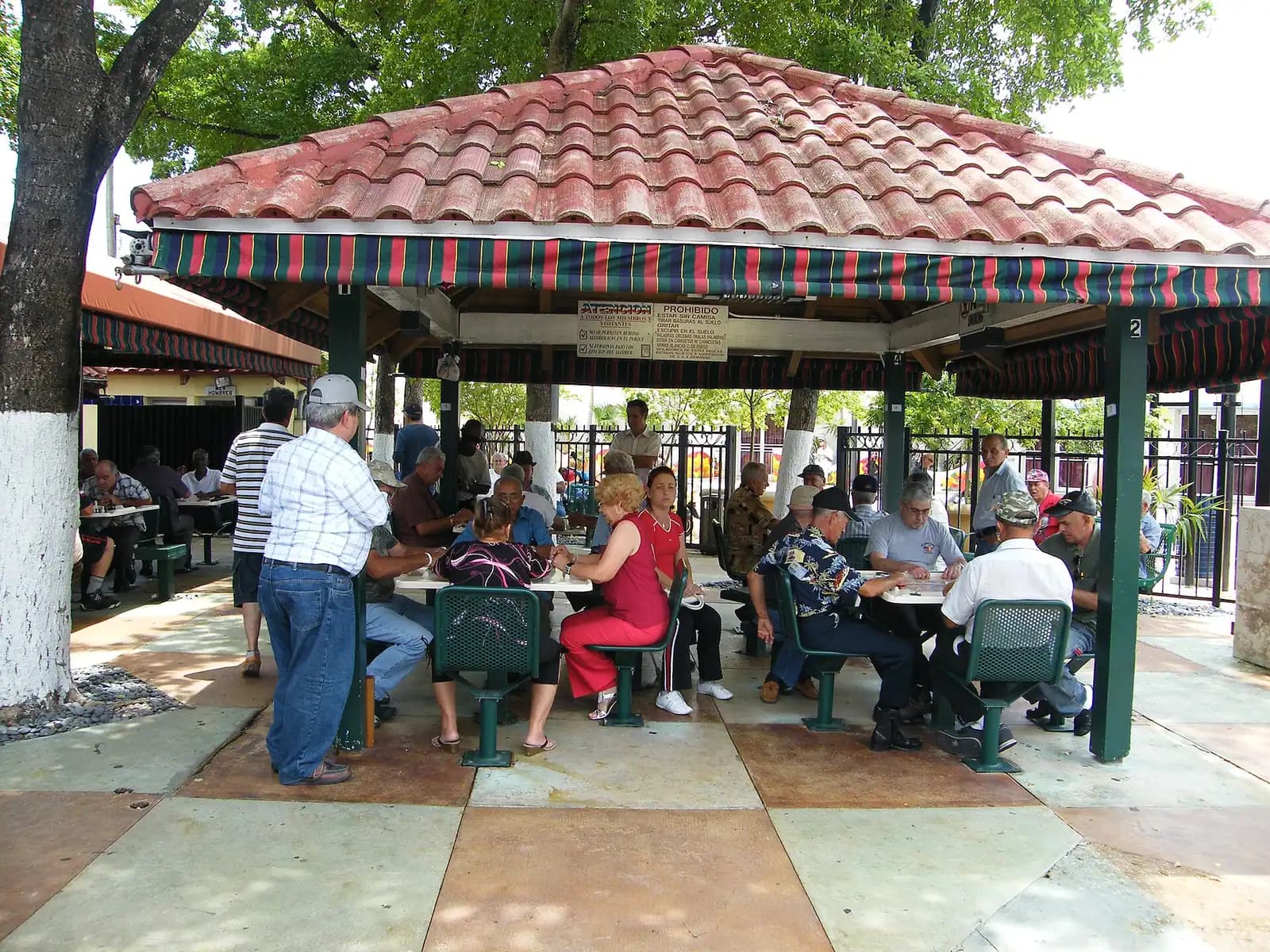
Máximo Gómez Park occupies a corner lot at SW 8th Street and SW 15th Avenue, and it is smaller than almost anyone expects — a walled quarter-acre of tiled tables under a pergola, hard against a busy one-way road. Everyone calls it Domino Park.

The thing to understand before you arrive is that this is not a demonstration. The men and women at the tables are neighbourhood residents playing a competitive, long-running, occasionally ferocious game, and the City of Miami restricts play to permit holders aged 55 and over. There is a registration process, there are house rules, alcohol is prohibited on the premises, and cheating is understood to carry permanent consequences. The park has functioned this way for decades, which is precisely why it still feels like what it is rather than what a tour operator would build.

Visitors are welcome, and the layout tells you exactly where you stand: a low perimeter wall and railing, with a clear line of sight across every table. You watch from there. Most days there are a dozen or more games running, dominoes clacking on tile, arguments conducted at volume in Spanish, and a good deal of chess and card play at the edges.

The park's name honours Máximo Gómez, the Dominican-born general who led Cuban forces through both wars of independence against Spain in the nineteenth century — a choice that says something about how the neighbourhood around it understands itself. The western wall carries a large mural of heads of state, painted for the Summit of the Americas that Miami hosted in 1994.

Ten or fifteen minutes is a normal visit. It is not an attraction with a route through it. It is a place to stand, listen to a game you probably cannot follow, and then walk fifty yards to a ventanita for coffee — which, with the Tower Theater directly across the street, is more or less the intended sequence.
Getting there and parking

The park is on the south side of SW 8th Street at SW 15th Avenue, in the middle of the walkable stretch of Calle Ocho.

On foot it is the obvious midpoint of a Little Havana walk — five minutes from Ball & Chain to the east, two minutes from Cuban Memorial Boulevard to the north, and directly opposite the Tower Theater.

Rideshare will drop you at the kerb. Roughly ten minutes from Brickell or downtown, twenty-five to forty from Miami Beach.

Driving, remember SW 8th Street is one-way eastbound here; the westbound pair is SW 7th Street one block north. There is metered kerbside parking on SW 15th Avenue and the neighbouring numbered avenues, and a couple of small paid lots. It fills on Friday and Saturday evenings.

Metrobus routes run along SW 8th Street. The free Metromover does not reach Little Havana.

There is no dedicated parking for the park itself.

Who gets to play, and why

The rules here are municipal, not informal, and they are the reason the park works.

  • Players must be 55 or over. This is not flexible and it is not a suggestion made to keep tourists out; it is how the City of Miami has run the park for decades.
  • Players must hold a permit. Registration goes through the city, and regulars are known to one another and to the attendant.
  • No alcohol on the premises, and no entry to anyone under the influence.
  • Cheating gets you removed, in some accounts permanently. The games are competitive and reputations here are long.
  • Visitors watch from the perimeter. There is no seating for spectators inside the playing area and no expectation that you will be invited to a table.

There have been periods when the park has run a looser arrangement on certain days, allowing non-members to sit in with identification. If you are set on playing, ask the attendant on the day rather than assuming — and be prepared for the answer to be no.

None of this is unfriendly. It is a neighbourhood institution with a membership, and the visitor's role in it is clearly defined and perfectly pleasant.

How to watch without being a nuisance

The single most common complaint from regulars is cameras in faces, so start there.

  • Ask before photographing a person. A gesture at the camera and a nod is enough. Wide shots of the pergola and the tables are uncontroversial; a lens pushed over someone's shoulder during a hand is not.
  • Do not lean over the tables. Players are reading a board and each other. Shadows and elbows are not welcome.
  • Keep your voice down. The noise in the park is the games. Adding a tour narration over the top of them is the fastest way to be resented.
  • Do not expect explanation. Cuban-style dominoes uses a double-nine set and partners play in pairs, but nobody at the tables is there to teach you, and asking mid-game will not land well.
  • Go at a normal hour. Mid-to-late afternoon is when the park is fullest. First thing in the morning there may be two tables going.

If you want to actually learn the game, several Little Havana walking-tour operators build a domino lesson into their itinerary at a different venue, which is a far better use of everyone's time than hovering here.

What is within fifty yards

The park is one stop on a very short walk, and treating it as a destination in itself guarantees disappointment.

Directly across SW 8th Street stands the Tower Theater, open since December 1926 and now operated by Miami Dade College. It screens art-house and Spanish-language films, frequently with subtitles in whichever language you do not have, and its neon tower is the most photographed structure on the street.

A block east the pavement carries pink marble stars honouring Latin performers, set into the walkway in the manner of Hollywood's.

A block north on SW 13th Avenue is Cuban Memorial Boulevard, a shaded strip of monuments including the eternal flame for Brigade 2506, the exile force defeated at the Bay of Pigs in 1961. It is quiet, sombre and almost always empty of visitors.

Either side on Calle Ocho are ventanitas, cigar storefronts with rollers working at the window, restaurants and Ball & Chain, the 1935 music venue on the 1400 block.

Put together, that is a two to three hour afternoon. The park is ten minutes of it, and it is the ten minutes people remember.

Tours that visit Domino Park

Operators run these trips past Domino Park, or stop there as part of a longer route. We list what the booking data supports — not everything that mentions the name.

Some links below go to Viator, our booking partner. We earn a commission on bookings made through them — at no extra cost to you, and with no influence on what we recommend.

Private and small-group departurespriced per boat or per vehicle, not per person

Near Domino Park

Straight-line distances, so allow more on the road — the island is long and has one main parkway.

  • A busy commercial street in Little Havana with Spanish-language shop signs and traffic running one way
    Free

    Dining district

    Calle Ocho

    SW 8th Street: eight walkable blocks of Cuban and Central American Miami, on a road that runs west until it becomes the Tamiami Trail.

    1.5–4 hoursFree. The street, the pavement stars and Viernes Culturales all cost nothing.80 ft away

  • A Cuban coffee window on a Miami street with customers standing at the counter drinking from small cups
    Free

    Neighbourhood

    Little Havana

    The neighbourhood Cuban exiles built west of downtown Miami, now shared with Nicaraguan and Honduran Miami and still entirely lived-in.

    2–5 hoursFree to walk. Individual venues, tours and shows charge their own admission.150 ft away

  • Glass residential and office towers rising above a tree-lined street in Miami's Brickell district
    Free

    Neighbourhood

    Brickell

    Miami's most walkable neighbourhood: towers, a free elevated train, and a two-thousand-year-old Tequesta site at the river mouth.

    1.5–5 hoursFree. Walking the district, riding the Metromover and visiting the Miami Circle all cost nothing.1.7 mi away

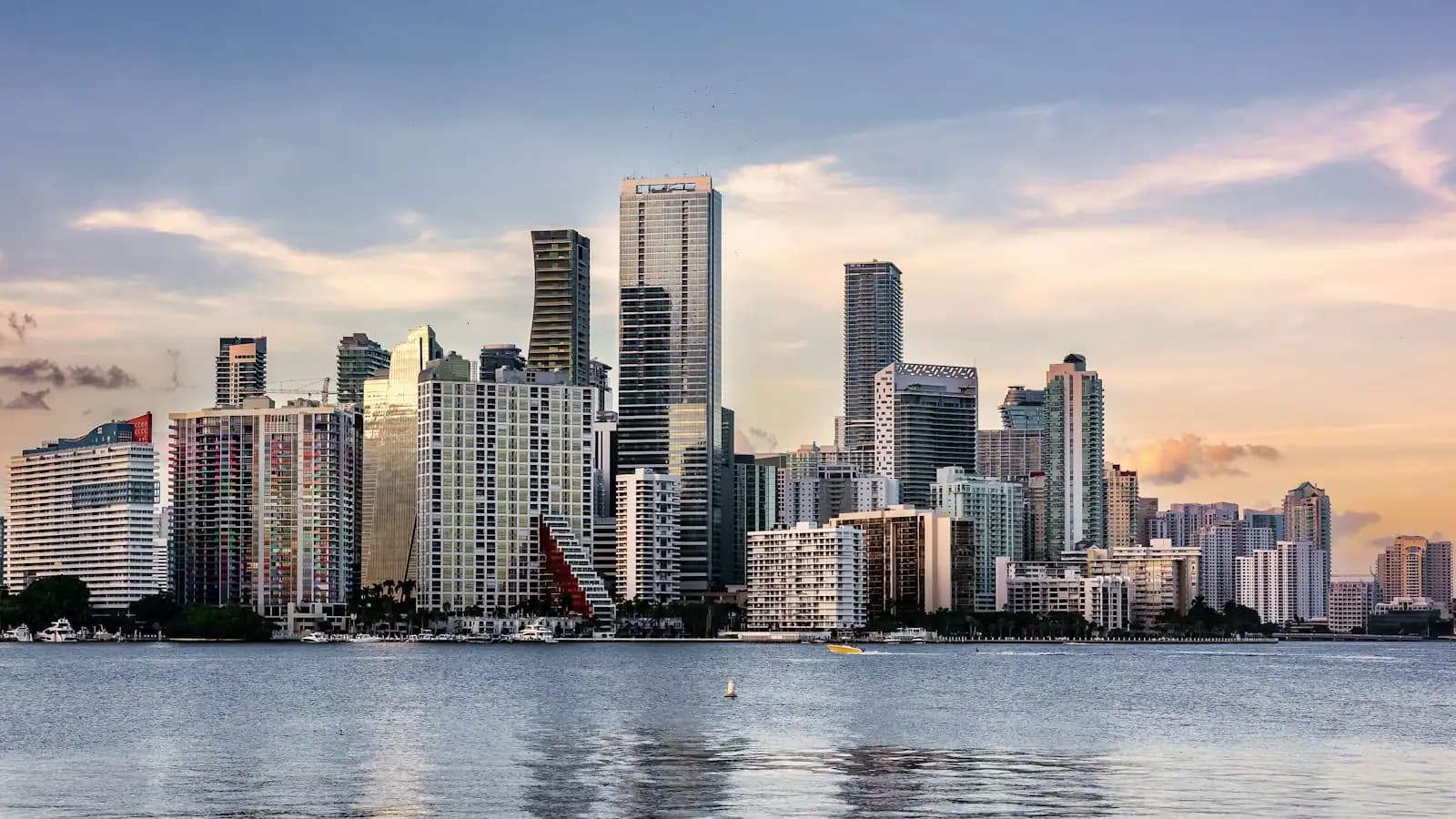
  • A dense cluster of downtown towers seen across water at the end of the day
    Free

    Neighbourhood

    Downtown Miami

    The original Miami: a railway terminus that became a city in 1896, now a downtown of towers, museums and a free elevated railway.

    3–8 hoursFree to walk, and the Metromover that connects it costs nothing. Museums, the Freedom Tower galleries, bay cruises and events are ticketed separately.1.7 mi away

Domino Park: common questions

Can tourists play dominoes at Domino Park in Miami?

Generally no. The City of Miami restricts play at Máximo Gómez Park to permit holders aged 55 and over, and the regulars are neighbourhood residents who play there most days. Visitors watch from the perimeter railing, which is how the park is laid out. Arrangements for occasional non-member play have existed at times, so it is worth asking the attendant on the day — but arrive expecting to spectate.

What are Domino Park's opening hours?

The park is generally open daily from around 9am to 6pm, though the tables fill and empty on their own schedule and there are far more games running mid-afternoon than first thing. Hours are set by the City of Miami and can change, so treat this as a guide rather than a guarantee. The park closes to normal use during the March street festival and sits inside the monthly Viernes Culturales closure.

Why is it called Máximo Gómez Park?

It is named for Máximo Gómez, the Dominican-born general who commanded Cuban forces in both nineteenth-century wars of independence against Spain. The naming reflects the neighbourhood's founding population of Cuban exiles, for whom the independence struggle is a live historical reference rather than a distant one. The park's western wall also carries a mural of heads of state painted for the 1994 Summit of the Americas, which Miami hosted.

How long should you spend at Domino Park?

Ten to fifteen minutes is a complete visit. The park is a walled quarter-acre with no route through it, no exhibits and no seating for visitors — you stand at the railing, watch a few hands, and move on. It works best as one stop on a two or three hour Calle Ocho walk that also takes in the Tower Theater opposite, Cuban Memorial Boulevard a block north, and lunch.