Skip to content
Search
Menu

We earn a commission if you book through this link. You pay the same price.

A geodesic dome structure standing open in a modern paved plaza surrounded by contemporary buildings
Sharon Hahn Darlin

Shopping

Miami Design District

Last updated

A luxury shopping quarter laid out as walkable streets, with a Buckminster Fuller dome and a free art museum in the middle of it.

The Design District occupies about twenty blocks north of Wynwood, and understanding what it is saves a lot of confusion: it is a privately developed luxury retail quarter, arranged as public streets rather than as a mall, with an art and architecture programme deliberately layered over the top.

The land was the Buena Vista furniture and design showroom district, a low-rise neighbourhood of warehouses and trade showrooms that had been declining for decades. From the 2000s the developer Craig Robins assembled it and rebuilt it as a fashion district, and the strategy was explicitly cultural: commission serious architecture and public art, make it free, and let that draw a public that luxury retail on its own would not.

It works, and it produces a genuinely unusual proposition. You can spend an afternoon here without entering a single shop. Palm Court, the central plaza, holds Buckminster Fuller's Fly's Eye Dome — a design he developed in 1965, fabricated in this version in 2014 — standing open and free in a courtyard framed by Sou Fujimoto's structure. ICA Miami, the Institute of Contemporary Art, charges nothing at all, ever, and its sculpture garden is likewise free. Museum Garage on NE 41st Street is a multi-storey car park whose façades were commissioned from several different designers working independently, producing a building that argues with itself. Public works by other designers are scattered across the district on a free art trail.

Then there is the retail, which is the point of the whole exercise: European fashion flagships, jewellery, furniture showrooms and restaurants at a price point that assumes you are not asking. The architecture housing them is frequently excellent.

The honest framing is this. If you like contemporary architecture, the Design District is one of the most interesting walks in Miami and costs nothing. If you came to shop and are not in that market, it will feel like a very handsome place to be ignored.

Wynwood is a mile south, Little Haiti immediately north.
Getting there and parking

The Design District sits on NE 2nd Avenue around NE 39th to 42nd streets, north of Midtown and south of Little Haiti.

Rideshare is the practical default: ten to twenty minutes from downtown or Brickell, twenty to forty from South Beach over the causeways.

The free City of Miami trolley runs a route linking the Design District with Midtown and Wynwood. No fare, no app, and slow.

Metromover does not come here. Its northern terminus is the Adrienne Arsht Center, roughly a mile and a half south, so it is not a route in.

Driving, several garages serve the district including Museum Garage on NE 41st Street, charged hourly with validation offered by some retailers and restaurants. Metered street parking is limited.

On foot, Wynwood is about a mile south through Midtown — walkable but exposed and dull in the middle. Little Haiti begins immediately to the north and the transition across NE 2nd Avenue is worth seeing on foot rather than from a car.

Everything here that costs nothing

The district's free layer is substantial and under-publicised, largely because the people publicising it would rather you bought a handbag.

  • The Fly's Eye Dome in Palm Court. Buckminster Fuller designed it in 1965 as a mass-producible shelter — an "autonomous dwelling machine" — and this version was fabricated in 2014. It sits open in the plaza, unfenced, accessible around the clock.
  • ICA Miami, the Institute of Contemporary Art. Admission is free, permanently and by policy, not on a particular day of the month. Rotating exhibitions of serious international contemporary work in a purpose-built building, plus a free sculpture garden behind it.
  • Museum Garage, NE 41st Street. Five façades by five different designers on one car park, commissioned independently so that they do not resolve into a single composition. It is the most argumentative building in Miami and it is a car park.
  • The public art trail. Commissioned works by designers including Konstantin Grcic and the Bouroullec brothers are placed through the streets and plazas, all free to see.
  • The architecture itself. Several flagship buildings are worth the walk on their own terms.

A ninety-minute self-guided loop takes in all of the above and costs nothing but the ride there.

How the district is laid out

The core sits between roughly NE 38th and NE 42nd streets, either side of NE 2nd Avenue and running east towards Biscayne Boulevard.

Palm Court is the centre of gravity — an open plaza with the Fly's Eye Dome, surrounded on several levels by retail and reached through a number of passages. Paradise Plaza to the east is the other main courtyard, with restaurants and a covered walkway. Jungle Plaza hosts events and installations.

ICA Miami sits on NE 41st Street at the northern edge of the retail core, with its sculpture garden behind.

The streets themselves were rebuilt with wide pavements, planting and lighting, and the district is genuinely walkable end to end in fifteen minutes.

Two edges matter. South across NE 36th Street the district gives way to Midtown and then Wynwood, about a mile away — walkable if you do not mind heat and a dull stretch in between. North, the district runs into Little Haiti, and the boundary is abrupt: high-end retail on one side, a working Haitian-American neighbourhood on the other. That line is the clearest illustration in Miami of what redevelopment money does and does not reach, and it is worth walking across rather than driving over.

Practicalities, parking and when to come

Parking is in several garages including Museum Garage itself, charged by the hour with validation offered by some retailers and restaurants. Street parking is limited and metered.

The free City of Miami trolley runs a route connecting the Design District with Midtown and Wynwood, which is the cheapest way to combine the three.

Metromover does not reach here — it ends at the Adrienne Arsht Center, about a mile and a half south. Rideshare is the default.

Best times. Late afternoon into early evening: the light is better for the architecture, the plazas are in shade, and the restaurants open. Shops generally keep standard retail hours and close earlier than you would expect on Sundays.

Art Basel week in early December turns the district into one continuous installation, with commissioned works, pop-ups and events. It is the best week to come and the busiest.

Summer afternoons bring the daily thunderstorm. Palm Court and Paradise Plaza have covered sections; most of the district does not.

Combining it: Design District, Wynwood and Little Haiti make a strong one-day arts circuit, and they are three genuinely different neighbourhoods rather than three versions of the same one.

Tours that visit Design District

Operators run these trips past Design District, or stop there as part of a longer route. We list what the booking data supports — not everything that mentions the name.

Some links below go to Viator, our booking partner. We earn a commission on bookings made through them — at no extra cost to you, and with no influence on what we recommend.

Near Design District

Straight-line distances, so allow more on the road — the island is long and has one main parkway.

  • A brightly painted market building with steep roofs and fretwork detailing on a Miami street
    Free

    Neighbourhood

    Little Haiti

    The centre of Haitian life in the Americas outside Haiti, on some of the highest ground in Miami and under corresponding pressure.

    1.5–4 hoursFree. The neighbourhood, the Caribbean Marketplace exterior and the cultural complex galleries cost nothing, and Big Night in Little Haiti is a free concert.1.1 mi away

  • A large colourful mural covering the whole flank of a single-storey warehouse in Miami's Wynwood district

    Landmark

    Wynwood Walls

    A ticketed courtyard of commissioned murals in a warehouse district where almost all the art outside the gate costs nothing.

    1–2.5 hoursTicketed. General admission has been listed anywhere from around $12 to the mid-$30s for adults depending on ticket type and seller, with reduced rates for children, students and seniors. The murals on the surrounding streets are free.0.9 mi away

  • The deep slatted canopy of Pérez Art Museum Miami shading an open veranda above the bayfront lawn

    Museum

    Pérez Art Museum Miami

    A bayfront museum on stilts with hanging gardens on its veranda, collecting the art of the Atlantic world rather than the usual canon.

    1.5–3 hoursTicketed, with adult admission recently around $16 and roughly $12 for students, seniors and ages 7–18; under-6s free. Free on the second Saturday of each month and regularly free on Thursday evenings.1.9 mi away

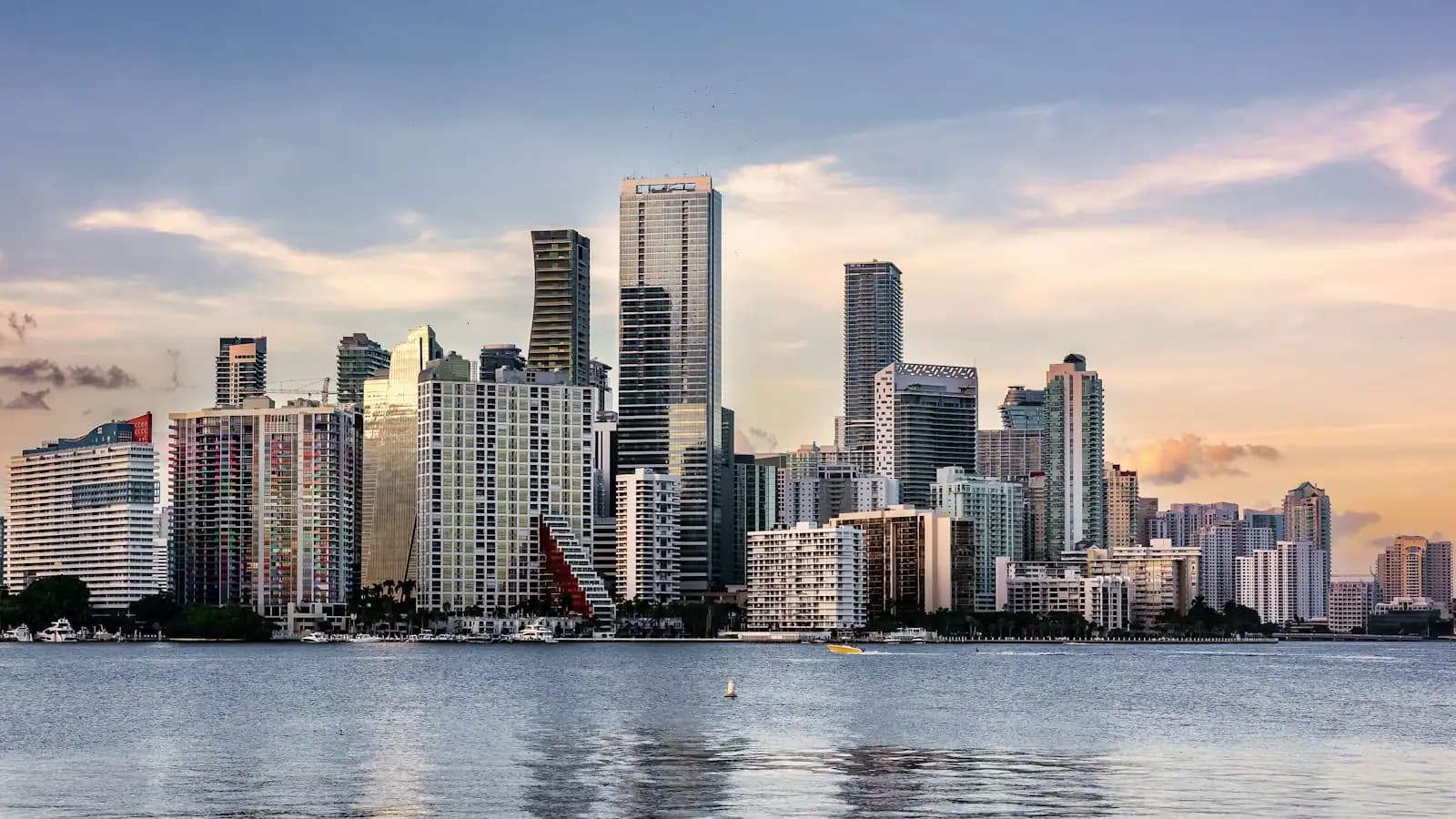
  • A dense cluster of downtown towers seen across water at the end of the day
    Free

    Neighbourhood

    Downtown Miami

    The original Miami: a railway terminus that became a city in 1896, now a downtown of towers, museums and a free elevated railway.

    3–8 hoursFree to walk, and the Metromover that connects it costs nothing. Museums, the Freedom Tower galleries, bay cruises and events are ticketed separately.2.7 mi away

Design District: common questions

Is the Miami Design District free to visit?

The district itself is free, and so is most of what is worth seeing in it. Buckminster Fuller's Fly's Eye Dome stands open and unfenced in Palm Court, ICA Miami charges no admission at all as a matter of permanent policy, its sculpture garden is free, and commissioned public works are placed along the streets. You pay only for parking, food and the luxury retail, which is priced accordingly.

What is ICA Miami and is it really free?

The Institute of Contemporary Art, Miami, is a contemporary art museum on NE 41st Street in the Design District, with rotating exhibitions of international work and a sculpture garden behind the building. Admission is free permanently — not on a designated free day or evening, but as standing policy. It is the best free art in Miami, and it is a two-minute walk from Palm Court and the Fly's Eye Dome.

Can you walk between Wynwood and the Design District?

Yes, though it is about a mile through Midtown with a fairly dull middle stretch and almost no shade. In summer most people take the free City of Miami trolley, which runs a route connecting Wynwood, Midtown and the Design District, or a short rideshare. The Metromover does not reach either neighbourhood — it ends at the Adrienne Arsht Center, a mile and a half south of the district.

What is Museum Garage in the Design District?

A multi-storey car park on NE 41st Street whose façades were commissioned from several different designers working independently of one another, so the finished building deliberately does not resolve into a single design. The result is one of the most argumentative structures in Miami, and it is a functioning garage you can park in. Seeing it costs nothing; parking in it is charged by the hour.

Is the Design District worth visiting if you are not shopping?

Yes, if contemporary architecture and art interest you. A ninety-minute loop takes in the Fly's Eye Dome, ICA Miami, Museum Garage and the public art trail without spending anything. If none of that appeals and you are not in the market for European fashion flagships, the district will feel like a handsome place with nothing for you — in which case Wynwood a mile south is the better use of the afternoon.