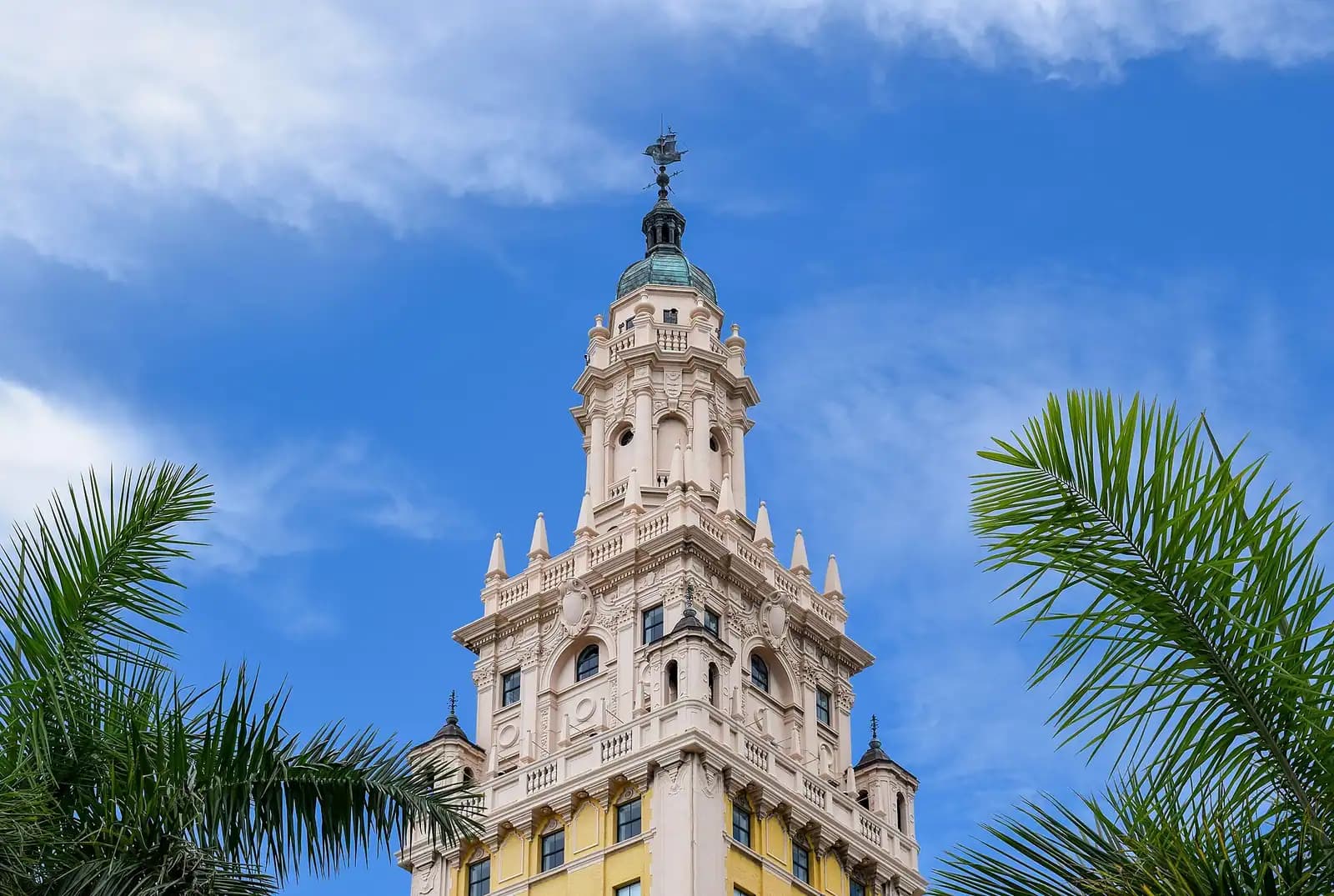
The Freedom Tower is the most important building in Miami, and for most of the last three years nobody could get into it.
It went up in 1925 as the home of the Miami News and Metropolis, designed by Schultze & Weaver at the height of the Florida land boom. The firm gave it a tower copied from the Giralda in Seville — the same reference they used a year later for the Biltmore Hotel in Coral Gables, which is why the two buildings look like siblings from a distance. For a few years it was the tallest thing in the city and the newspaper's presses ran underneath it.
Its second life is why it matters. In 1962, in the aftermath of the Cuban revolution and the Bay of Pigs, the federal government leased the by-then-empty building as the Cuban Refugee Emergency Center. For twelve years it was where Cubans arriving in Miami were registered, medically examined, given financial and resettlement assistance, and in many cases fed and clothed. Through it passed hundreds of thousands of people, including most of those arriving on the twice-daily Freedom Flights between 1965 and 1973. It is Miami's Ellis Island, and for a substantial share of this city's population it is the building a parent or grandparent walked into on their first day in the United States.
It closed as a refugee centre in 1974, went through decades of uncertain ownership and near-demolition, was designated a National Historic Landmark in 2008, and is now owned by Miami Dade College, which runs its Museum of Art and Design here.
It closed again in July 2023 for a restoration reported at around twenty-five million dollars — structure, interiors and the full exterior — and reopened to the public on 16 September 2025, a hundred years after it was built. The new interpretation puts the Cuban refugee experience at the centre rather than in a side gallery.
Check hours before you come. Programming is still settling.