Skip to content
Search
Menu

We earn a commission if you book through this link. You pay the same price.

A stone Mediterranean-revival house with arched loggias seen across a lawn under palms
National Weather Service

Historic site

Deering Estate

Last updated

Charles Deering's bayfront estate: an 1896 pioneer hotel, a 1922 stone house, and a Paleoindian fossil site in the pine rockland behind.

Photo: National Weather ServicePublic domain

First, the confusion, because it costs people a morning. There are two Deering estates on Biscayne Bay, built by two brothers, about eight miles apart. Vizcaya, in Coconut Grove, is James Deering's Italianate villa with the formal gardens and the stone barge. The Deering Estate, in Palmetto Bay, is Charles Deering's — older brother, different temperament, different building, and far fewer visitors. They are not the same place and you cannot walk between them.

Charles Deering bought up most of the little bayfront town of Cutler between 1914 and 1917 and absorbed it into his property. What survives from the town is Richmond Cottage, a wooden house built in 1896 by Samuel Richmond, extended and opened in 1900 as the Richmond Inn — the first hotel between Coconut Grove and Key West. It is one of the oldest wooden structures left standing in Miami-Dade County and the last piece of Cutler.

Next to it Deering built the Stone House, finished in 1922: Mediterranean Revival, cut coral rock, iron grilles, built partly to hold an art collection that at one point included work by Whistler and Sargent. He lived there until he died on the property in 1927. The state bought the estate in 1985 and it is run today as a historic site and nature preserve.

The part that genuinely has no equivalent in Miami is behind the houses. The estate's 444 acres take in pine rockland, hardwood hammock, mangrove and salt marsh, and within them sit the Cutler Fossil Site — a solution hole that yielded Pleistocene megafauna bones and evidence of Paleoindian occupation — and the Cutler Burial Mound, a Tequesta mound and one of very few prehistoric mounds still intact in the county.

You reach those on a guided natural-area walk, not on your own. Book it.

Getting there and parking

From downtown Miami, take US-1 south for roughly 30 minutes, then turn east on SW 168th Street and follow it to SW 72nd Avenue. The entrance is signed. Allow longer in weekday afternoon traffic, which on US-1 south of Kendall is consistently poor.

From Coral Gables or Coconut Grove, Old Cutler Road south is slower but far more pleasant, and it links the estate to Matheson Hammock and Fairchild along the way.

Parking is on site and included with admission.

Public transport is workable but slow: the South Dade TransitWay busway runs parallel to US-1 with stops within a mile or so of the estate, and the last stretch is a walk along roads without much shade. Rideshare from Coconut Grove takes about 25 minutes and is the practical non-driving option.

The two houses

Richmond Cottage (1896). A frame building of Dade County pine with wide verandahs, built as a family home in a town of a few dozen people and turned into a hotel four years later because travellers on the coastal route had nowhere else to sleep. It was badly damaged by Hurricane Andrew in 1992 and rebuilt to its original form. Standing on the porch, it is worth remembering that when this was built Miami did not yet exist as a city and the railway had not arrived.

The Stone House (1922). Coral rock, arched loggias, heavy ironwork, and a plan organised around display rather than comfort — Charles Deering had a serious collection and built a wing to hold it, with a vault. The interiors are furnished to the 1920s and the tour covers both the art and the household. Look for the wine cellar, which has its own Prohibition-era story.

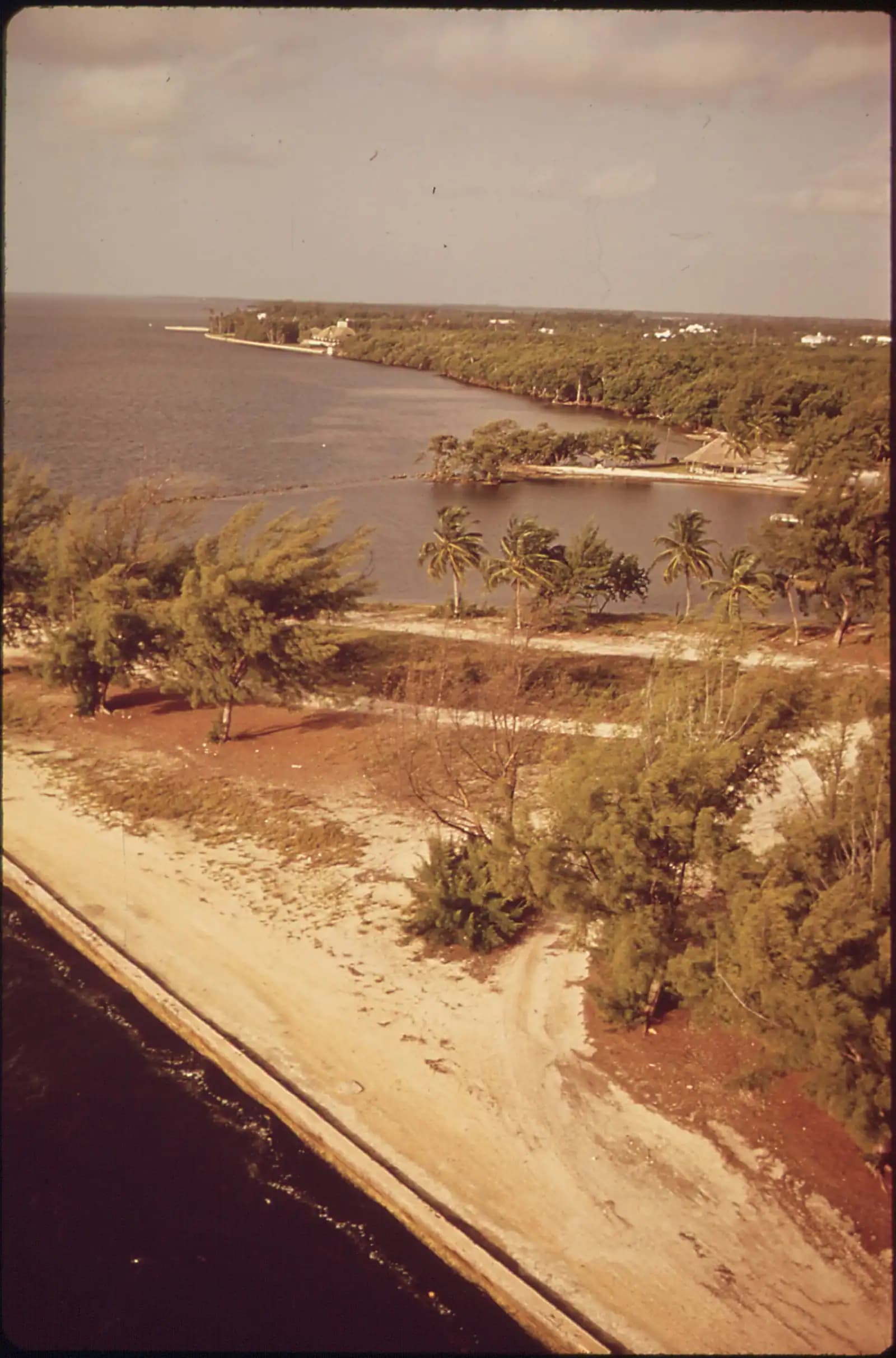
The boat basin. Deering cut a basin into the limestone in front of the houses so his yacht could come in. It is still there, and it is the best spot on the property: rock edge, mangrove, open bay, and no development in the view.

House access is by guided tour on a set schedule rather than free roaming. The tours are good and unhurried, and they are included with admission.

The fossil site and the burial mound

The Cutler Fossil Site is a solution hole — a natural pit dissolved in the limestone — that acted as a trap and then as a shelter. Excavations have produced bones of Pleistocene megafauna alongside evidence of human occupation reaching back to the Paleoindian period, which makes it one of the most significant archaeological sites in South Florida.

The Cutler Burial Mound holds Tequesta burials. The Tequesta were the people who lived on this coast for roughly two thousand years before European contact, whose settlement at the mouth of the Miami River is marked today by the Miami Circle. Very few of their mounds survive in a county that has been comprehensively bulldozed; this is one.

Both are reached on guided natural-area tours only, typically running once a day in the cooler months, roughly October to May, and included with general admission. The walk is an hour or so on private trails through pine rockland and hammock with a naturalist, and it covers the habitat as much as the archaeology — pine rockland is globally imperilled and almost all of what is left in the world is in Miami-Dade County.

Treat the mound as what it is. Photography policies apply and the guides will tell you where the line is.

The preserve, and getting on the water

The estate is 444 acres and the houses take up a small fraction of them.

  • Pine rockland, the habitat that once covered the coastal ridge from here to Miami and now survives in fragments. Slash pine over exposed limestone, with an understorey of endemic plants found nowhere else.
  • Tropical hardwood hammock, dense and shaded, with gumbo limbo, mastic and live oak.
  • Mangrove and salt marsh at the bay edge, which is why the shoreline here looks like the Everglades rather than like Miami.
  • Canoe and kayak programmes to Chicken Key, an uninhabited island about a mile offshore inside the estate's boundary. These run as scheduled guided paddles and as volunteer clean-up trips; they are the best thing the estate does and they book out.
  • Butterfly walks, birding walks and the estate's own arts programming, including concerts and a residency for artists.

Practical notes: the trails are natural surface, mosquitoes are serious in the wet season, and much of the property is off-limits without a guide, which is a conservation decision rather than an inconvenience. Wear closed shoes. Bring water and repellent.

Admission, timing and pairing it

Admission is in the region of $18 for adults and roughly $10 for children, with under-fours generally free. Verify current rates before you go. That price includes the house tours and the guided natural-area walk when it is running, which makes it good value compared with almost anything else in the city.

Timing. The guided nature walks run in the cooler half of the year, roughly October through May, and typically once a day around midday. If the archaeology is why you are coming, plan the visit around that departure rather than hoping.

Duration. Two to three hours does the houses, the basin and a walk. Four if you add a paddle or a programme.

Pairing. This is the far south of the metropolitan area, about 25 minutes past Coral Gables. The sensible combination is Deering Estate with Fairchild Tropical Botanic Garden and Matheson Hammock, all strung along the Old Cutler corridor, or with Zoo Miami further west. Pairing it with Vizcaya in the same day is possible but it is a lot of house.

Not to do: arrive at four expecting a full visit. The last tours go earlier than the gate closes.

Tours that visit Deering Estate

Operators run these trips past Deering Estate, or stop there as part of a longer route. We list what the booking data supports — not everything that mentions the name.

Some links below go to Viator, our booking partner. We earn a commission on bookings made through them — at no extra cost to you, and with no influence on what we recommend.

Private and small-group departurespriced per boat or per vehicle, not per person

Near Deering Estate

Straight-line distances, so allow more on the road — the island is long and has one main parkway.

  • A calm circular saltwater pool ringed by sand and mangrove with a distant city skyline

    Park

    Matheson Hammock Park

    A man-made tidal pool cut into the mangrove edge in the 1930s, flushed by the bay and framed by the downtown skyline.

    2–5 hoursA per-vehicle parking charge at the gate, higher at weekends. Entry on foot or by bicycle is free. Boat ramp and marina use are charged separately.4.9 mi away

  • A wide lawn framed by a variety of tall palm species under a bright subtropical sky

    Park

    Fairchild Tropical Botanic Garden

    Eighty-three acres of palms and cycads on Old Cutler Road: a serious conservation institution dressed as a pleasant morning out.

    2–4 hoursTicketed, recently around $25 for adults, about $18 for seniors and roughly $12 for children aged 3–11, with under-3s free. The tram tour and butterfly conservatory are included.4.7 mi away

  • A giraffe standing in an open grassy enclosure with no visible fencing in the foreground

    Wildlife

    Zoo Miami

    Florida's largest zoo: 750 acres of moated, cage-free habitat where the animals are tropical and the walking is the hard part.

    4–6 hoursExpect roughly $25 for an adult and a few dollars less for a child, with very young children free. Parking, tram, safari cycle hire and animal encounters are extra.5.7 mi away

  • A Mediterranean Revival building with barrel-tile roof, arcades and stucco walls under palms
    Free

    Neighbourhood

    Coral Gables

    A whole city planned and sold in the 1920s to one Mediterranean design code, and still enforcing it a century later.

    2.5–6 hoursFree to visit the city, Miracle Mile and the residential streets. The Venetian Pool, the Coral Gables Museum and Fairchild Tropical Botanic Garden each charge their own admission.9.7 mi away

Deering Estate: common questions

Is the Deering Estate the same as Vizcaya?

No. They were built by two brothers on the same bay, about eight miles apart. Vizcaya, in Coconut Grove, is James Deering's Italianate villa with the formal gardens and the stone barge. The Deering Estate, in Palmetto Bay, is Charles Deering's: an 1896 wooden cottage, a 1922 coral rock house, and 444 acres of pine rockland, hammock and mangrove with an archaeological site in it. Vizcaya gets the crowds; this one gets the nature.

Can you see the Tequesta burial mound at the Deering Estate?

Only on a guided natural-area tour. The Cutler Burial Mound and the Cutler Fossil Site sit on private trails behind the houses, and access is with a naturalist rather than on your own. These walks typically run once a day in the cooler months, roughly October to May, and are included with general admission. If the archaeology is your reason for visiting, plan the day around the tour departure time.

How much does the Deering Estate cost?

Expect around $18 for adults and roughly $10 for children, with young children free. That normally includes the guided house tours and the natural-area walk when it is running, which makes it good value for a two-to-three-hour visit. Canoe programmes to Chicken Key, concerts and evening events are ticketed separately. Verify current rates before you travel, as they are reviewed periodically.

How long do you need at the Deering Estate?

Two to three hours covers the Stone House, Richmond Cottage, the boat basin and a guided walk. Four if you add a paddling trip or an arts programme. Because the house tours and nature walks run at fixed times rather than continuously, the practical answer is to check the day's schedule when you arrive and build around it — turning up late in the afternoon usually means missing both.

Is the Deering Estate worth the drive from Miami Beach?

It is about an hour from South Beach in traffic, so treat it as a half day rather than a stop. It is worth it if you want the parts of Miami that predate the city: a pioneer hotel from 1896, a 1920s collector's house, a Tequesta mound and the last fragments of pine rockland. If you have only one historic house day and no car, Vizcaya in Coconut Grove is far easier to reach.